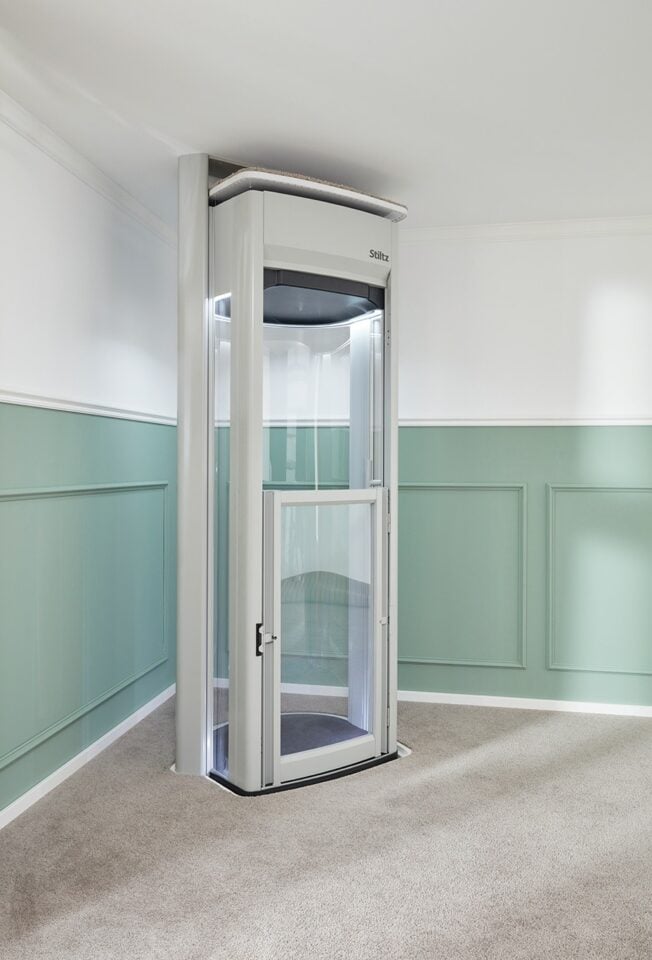
A pneumatic vacuum lift can be worth considering when it provides useful access between floors, fits your property and comes with dependable installation and maintenance support. Its value depends on how well it meets those requirements, alongside the complete cost of ownership.
The distinctive appearance and installation arrangements appeal to some homeowners. However, cabin size, entrance space, operating noise and servicing deserve just as much attention as the design.
At DHG Services, we help homeowners assess mobility equipment around their property and daily needs. This guide explains what to consider before deciding whether a pneumatic vacuum lift is a worthwhile addition to your home.
What Is a Pneumatic Vacuum Lift?
A pneumatic vacuum lift uses differences in air pressure to raise its cabin. Descent uses gravity and controlled airflow.
The system still needs electricity to operate. “Air-driven” describes the lifting mechanism; it does not mean the equipment works without an electrical supply.
Pneumatic Vacuum Elevators, commonly known as PVE, offers several residential models with different cabin sizes and capacities. Its range includes single-passenger options and a larger wheelchair-accessible model. See the manufacturer’s residential lift range.
When requesting a quotation, establish the exact manufacturer and model. Features associated with one pneumatic lift should not automatically be assumed to apply to every product in the category.
The Main Benefit Is Useful Access Between Floors
The strongest reason to install a home lift is the difference it makes to everyday life.
Consider the journeys you currently find difficult. You may want easier access to an upstairs bedroom, need to move between living areas on different floors or wish to reduce reliance on the staircase.
Then assess the proposed lift against those journeys. Its position should provide convenient access to the rooms you need, with manageable entrances at both ends.
For example, a lift arriving in a bedroom may be useful if the bathroom is nearby and accessible. It may offer less benefit if the remaining route includes narrow doorways or additional steps.
The investment makes more sense when the proposal addresses the complete access problem.
Installation Requirements Can Be an Advantage
PVE describes its cylindrical residential lifts as self-supporting systems that do not require a separate conventional shaft, pit or machine room. Those characteristics can make them worth investigating in an existing house. The arrangements are explained in its product range information.
However, the property still needs to be assessed for the chosen installation.
Ask about floor openings, structural support, electrical preparation and clearances. Establish where the operating equipment will be positioned and how installers will bring the lift components into the building.
Request a complete description of the associated work. A product that avoids one type of construction may still require alterations elsewhere.
Compare surveyed proposals rather than assuming that a pneumatic lift will always be simpler or cheaper to install.
Cabin Size and Wheelchair Access Need Careful Checking
A compact external footprint is useful only if the lift also accommodates the intended passenger.
Check the usable cabin dimensions, entrance width and rated load. If you use a wheelchair, provide its actual measurements, including footrests and other projections, together with the combined weight of the chair and user.
PVE identifies its PVE52 as a wheelchair-accessible model, but suitability still needs checking against the individual chair and installation. See the PVE52 product specifications.
Discuss how you will enter and leave at each landing. Establish whether reversing is necessary and whether there is enough space to manoeuvre outside the doors.
If another person needs to travel with you, confirm both the capacity and the available room. An advertised passenger count does not replace that assessment.
Consider How the Lift Will Look in Your Home
A pneumatic lift can become a prominent feature within a room. Whether that is an advantage depends on your preferences and the proposed location.
Look at the full installation, including the enclosure, doors, upper equipment and connections to each floor. Ask for drawings or photographs of the same model in comparable settings.
Think about sightlines from seating areas and the effect on furniture placement. A design you like in a showroom may feel different beside your dining table or bedroom entrance.
Where possible, review finish samples and see the equipment in person. The aim is to choose an installation you are comfortable living with every day, as well as one that provides the access you need.
Listen to the Lift Before Deciding
Operating noise is an important part of the comparison, particularly near bedrooms or quiet living spaces.
PVE offers different machinery configurations intended to manage sound in different home layouts. Its guidance on operating noise explains these options.
Ask which arrangement is included in your quotation and where the machinery would sit. Check whether a different configuration changes the installation requirements or price.
A demonstration is especially useful. Listen from inside the lift and from nearby rooms where possible, and ask whether the demonstration uses the same equipment arrangement being proposed for your home.
Descriptions such as “quiet” are less useful than understanding the sound you can expect in your particular setting.
Compare the Complete Installed Cost
A reliable quotation should identify the lift, its capacity, the number of stops and the selected features.
It should also explain delivery, installation, testing and handover, together with any building and electrical work. Establish whether decoration, flooring and making good are included.
Ask which items remain provisional and what further information is needed to confirm them. Check the total payable, applicable VAT treatment, deposit and payment stages.
When comparing alternatives, use equivalent requirements. A smaller cabin or a proposal excluding preparation work may appear cheaper without offering the same result.
The most useful comparison is between complete installations that meet your needs, rather than advertised starting prices.
Running Costs Should Be Based on Your Expected Use
Electricity costs depend on the chosen equipment, journey frequency, travel distance and your tariff.
PVE explains that its lifts use electricity principally for ascent, with gravity-assisted descent. That operating principle does not establish the total running cost of a particular installation. See its electricity-use guidance.
Ask the supplier for an estimate based on realistic daily use. Clarify whether the calculation includes standby consumption and supporting equipment.
Avoid judging ownership costs from electricity alone. Servicing, replacement components and repair callouts also belong in the budget.
A written breakdown makes it easier to compare a pneumatic lift with another suitable home lift over the period you expect to use it.
Maintenance and Local Support Matter
Before ordering, establish who will maintain the exact model in your area.
Ask for the maintenance schedule, warranty conditions and current servicing charges. Find out how inspections, replacement components and repairs are handled, and whether any work must be completed by a specifically trained provider.
PVE’s technical information discusses components such as turbines, valves and seals as part of fault diagnosis and repair. A pneumatic lift should therefore not be treated as maintenance-free. See its residential lift repair guidance.
Our experienced DHG Services team can discuss the installation and support arrangements associated with a proposed system.
Clarify contact details, service coverage and parts availability before the lift becomes part of your daily routine.
Understand What Happens During a Power Cut
Emergency arrangements are another point to check for the specific model.
PVE describes controlled descent during a power failure, allowing the passenger to leave at the designated lower landing. This is an emergency function, rather than a promise that normal travel can continue throughout an outage. See the manufacturer’s power-cut guidance.
Ask the installer to explain the procedure during handover and provide the operating instructions. Establish how passengers call for assistance if needed.
Also consider how you would manage if the lift were temporarily unavailable because of a fault or planned maintenance. This is particularly relevant where essential rooms are on different floors.
Will a Pneumatic Lift Increase Property Value?
Do not base the purchase on an assumed increase in resale value.
A future buyer may appreciate improved access, while another may place greater importance on the space occupied or the ongoing maintenance commitment. The outcome will depend on the property and the buyer.
If resale is central to your decision, seek a local property professional’s opinion on the proposed installation. Keep that separate from the supplier’s equipment quotation.
For many households, the more useful assessment is personal: which rooms will become easier to use, how often will the lift help and how does the total cost compare with other suitable adaptations?
Those benefits can be considered without relying on a promised financial return.
Compare Pneumatic Lifts with Other Mobility Options
A pneumatic lift is one option within a wider range of home accessibility equipment.
Compare it with suitable through-floor or enclosed platform lifts using the same requirements for cabin space, entrances, travel and aftercare. Ask each supplier to explain why its proposal suits your home.
A stairlift may also be worth assessing where seated travel and transfers are manageable. Local customers can explore our stairlifts in Dudley service when considering that alternative.
The right choice should reflect the user’s needs and the property layout. A distinctive operating system or appearance should support that decision rather than determine it.
Frequently Asked Questions
Are pneumatic vacuum lifts suitable for every home?
No. Suitability depends on the available space, structural conditions, travel route and intended user. A survey is needed to establish whether a particular model can be installed appropriately.
Can a pneumatic lift carry a wheelchair?
Some models are designed for wheelchair access, but smaller passenger models may not be suitable. Check the actual chair dimensions, combined load and approach space against the proposed specification.
Are pneumatic lifts maintenance-free?
No. Obtain the manufacturer’s maintenance requirements and the installer’s service arrangements in writing. Include servicing and potential repairs when comparing ownership costs.
Can pneumatic lifts serve more than two floors?
Certain models offer several stops. Confirm the permitted travel height, number of entrances and configuration for the exact model being quoted.
When might another lift be a better choice?
Another system may be preferable if it offers more suitable cabin space, easier entrances, a better position within the property or more practical local support. Compare complete proposals that meet the same access needs.
Decide Whether a Pneumatic Lift Suits Your Home
A pneumatic vacuum lift can be a worthwhile purchase when it provides comfortable, useful access and its installation and ownership costs fit your plans.
Begin with a survey, compare suitable alternatives and arrange a demonstration where possible. Review the cabin, noise, building work and aftercare before committing.
Contact DHG Services to arrange a free home survey and discuss your requirements. We can help you explore suitable mobility solutions and obtain a written quotation for your property.