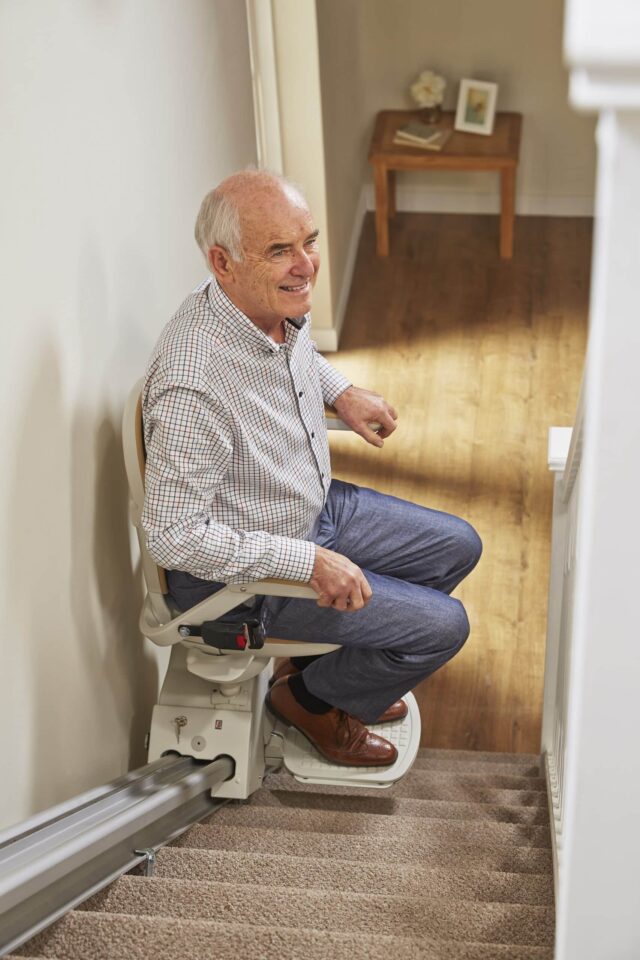
A stairlift can restore comfortable access between floors when climbing the stairs becomes difficult, painful or unsafe. However, choosing the right system involves more than deciding whether a lift will physically fit your staircase.
The stairlift must suit the user’s mobility, transfer ability, body position and expected long-term needs. Its rail must also fit the staircase without obstructing important doors, walkways or landing areas.
This guide explains the different types of stairlift available in the UK, the factors affecting stairlift prices and what to expect from a professional home survey and installation. It also covers safety features, new and reconditioned models, aftercare and alternatives for people who cannot transfer safely onto a stairlift seat.
DHG Services supplies and installs stairlifts across Stafford, Staffordshire and the West Midlands. Our experienced team provides free home surveys, fixed written quotations and clear recommendations without high-pressure selling.
When Should You Consider Buying a Stairlift?
Mobility changes do not always happen suddenly. Many people continue using the stairs even when each journey causes pain, fatigue or anxiety. They may begin limiting the number of trips they make, holding the handrail more tightly or relying on another person for support.
These changes can gradually restrict access to bedrooms, bathrooms and other important rooms. A stairlift provides a controlled seated journey along the staircase, allowing the user to travel between floors without climbing each step.
It may be time to consider an assessment if the stairs are affecting your confidence, causing discomfort or changing how you use your home. The NHS advice on preventing falls also explains how mobility, vision, medicines and household conditions can influence fall risk.
A stairlift will not suit every person. The user must be able to reach the staircase, transfer onto the seat and leave it safely at the destination. Where this is difficult, a through-floor or home lift may be more appropriate.
How to Choose the Right Type of Stairlift
The shape of the staircase is one of the first factors used to identify a suitable stairlift. Straight and curved stairlifts use different rail systems, manufacturing processes and installation methods.
The survey must also consider the person using the lift. Seat dimensions, weight capacity, posture, joint movement and the ability to operate the controls can all affect the recommendation.
Straight Stairlifts
A straight stairlift is designed for a staircase that runs in one continuous line without bends, corners or intermediate landings. The rail is usually manufactured in a standard straight section and cut or configured to suit the measured staircase.
Straight systems are generally less expensive and quicker to supply than bespoke curved models. They can include folding seats, arms and footrests to preserve space for other people using the stairs.
The installation must still allow safe access at both ends. Doors, radiators, entrance halls and circulation routes near the bottom of the stairs may require a hinged or retractable rail.
Explore the available straight stairlifts supplied by DHG Services.
Curved Stairlifts
A curved stairlift is required when a staircase contains bends, corners, intermediate landings or multiple connected flights. Its rail is designed around the individual staircase rather than adapted from a standard straight section.
Accurate measurements are essential because the rail must follow the staircase closely while providing suitable clearance from walls, balustrades and surrounding features. The planned parking position should also allow the user to transfer safely without unnecessarily restricting the landing.
Curved stairlifts normally cost more than straight models because the rail requires individual design and manufacture. Lead times can also be longer, although the final fitting can often be completed during one planned installation visit.
DHG Services can survey and recommend curved stairlifts for complex domestic staircases.
Outdoor Stairlifts
An outdoor stairlift can improve access over external steps leading to an entrance, garden or raised area. These systems are designed with weather-resistant components, suitable upholstery and protective covers.
The survey should assess the condition and width of the steps, the route to the stairlift and the space available for transferring at each end. Drainage, exposure to weather and access to a power supply may also affect the installation.
An external stairlift still requires regular inspection and maintenance. Leaves, dirt, ice and other debris should not be allowed to obstruct the rail or moving components.
Can You Use a Stairlift Safely?
The user must be able to approach the stairlift, sit in an appropriate position and remain secure throughout the journey. They must also be able to transfer away from the seat safely at the upper and lower landings.
Reduced hip or knee movement can affect how easily someone sits down or stands up. A person with limited hand movement may need a control that requires very little pressure, while someone who cannot turn safely at the landing may benefit from a powered swivel seat.
The required weight capacity must be established before a stairlift is selected. Capacity varies between products, so it should never be estimated or assumed from the appearance of the equipment.
A survey should also consider whether the user’s mobility is expected to change. A stairlift that meets an immediate need may not provide an appropriate long-term solution if wheelchair use or assisted transfers are likely.
Stairlift Safety and Comfort Features
Modern stairlifts can include several features designed to support controlled movement and comfortable daily use. The exact specification varies between manufacturers and models.
A seatbelt helps the user remain securely seated during travel. Obstruction sensors can stop the lift if the footrest or carriage meets an object on the staircase. Smooth starting and stopping can make the journey more comfortable for people affected by pain, balance difficulties or joint problems.
A swivel seat allows the user to turn away from the open staircase before standing. Powered versions may be helpful when operating a manual lever or rotating the seat would be difficult.
Folding seats, arms and footrests can reduce the space occupied when the lift is parked. Remote controls allow the stairlift to be called from another floor, while a key switch can restrict unauthorised operation.
Most domestic stairlifts use batteries that are recharged from the mains supply. This arrangement may allow limited continued use during a power cut, provided the batteries are charged and in suitable condition.
How Much Does a Stairlift Cost in the UK?
Stairlift prices depend on the staircase, selected model, required features and installation conditions. A standard straight stairlift is generally the least expensive option because it uses a relatively simple rail.
Indicative prices for new straight stairlifts can commonly fall between approximately £2,000 and £6,000. Bespoke curved stairlifts may range from around £5,000 to £15,000 or more, depending on the length and complexity of the route.
These figures should only be treated as broad guidance. The final cost can be affected by powered swivel seats, hinged rails, increased weight capacity, alternative seat designs, upholstery choices and unusual installation requirements.
Curved rails are manufactured for a particular staircase, which accounts for much of the price difference. The number of bends, landings and parking positions can all influence the design.
A written quotation following a home survey provides a more dependable figure than an estimate given without measurements. It should clearly explain the equipment, optional features, installation, warranty and any other anticipated charges.
New, Reconditioned or Rental Stairlifts
A new stairlift provides equipment selected specifically for the user and staircase. It can offer the widest choice of features, upholstery and configuration, along with the applicable manufacturer and installer warranty.
A professionally reconditioned stairlift may provide a more affordable alternative. The equipment should be inspected, tested and prepared for reuse by a competent specialist. Buyers should ask which components have been checked or replaced and what warranty and aftercare are included.
Reconditioned straight rails can often be adapted to another compatible staircase. Curved rails are more difficult to reuse because they are individually designed around a specific route.
Rental may be worth considering when the stairlift is required temporarily, such as during recovery from surgery or while longer-term arrangements are being made. Availability, minimum rental periods, installation charges and removal costs should be confirmed before agreeing to the service.
The cheapest initial option will not always provide the best value. Suitability, reliability, warranty and access to repairs should form part of the comparison.
What Happens During a Stairlift Home Survey?
A professional home survey allows the staircase and the intended user to be assessed together. It should produce a recommendation based on daily use rather than measurements alone.
The surveyor will examine the staircase length, width and angle, along with bends, landings, bannisters and surrounding walls. They will also check the available space at the top and bottom and identify doors, radiators or other features that could affect the rail.
The user’s mobility, transfer ability, weight, posture and reach should be discussed. This helps determine the required seat, controls, swivel mechanism and weight capacity.
Other household members must still be able to use the staircase. The folded dimensions of the stairlift and the proposed parking position should therefore be considered before the equipment is ordered.
Following the survey, you should receive a clear recommendation and written quotation. There should be an opportunity to ask questions and understand any optional features without pressure to make an immediate decision.
The Stairlift Buying Process with DHG Services
The process begins with a conversation about the user, staircase and reason for considering a stairlift. DHG Services then arranges a free, no-obligation home survey at a convenient time.
During the visit, the surveyor measures the staircase and discusses how the user approaches, transfers onto and operates the lift. Suitable straight, curved or alternative systems can then be compared.
The written quotation will explain the recommended equipment and included features. Where additional options are available, their purpose and cost should be made clear before an order is placed.
Once the chosen system is ready, an installation appointment is arranged. The engineer fits the rail to the staircase, installs the carriage and seat, and completes the required operational and safety checks.
Before leaving, the engineer demonstrates the controls and allows the user to become familiar with the stairlift. Warranty, servicing and fault-reporting arrangements should also be explained during handover.
How Long Does Stairlift Installation Take?
The timescale depends on the stairlift and the amount of preparation required. A straightforward straight stairlift can often be installed within a few hours once the correct equipment is available.
A curved system requires a bespoke rail to be measured and manufactured before installation. This can create a longer lead time, although the fitting itself may still be completed during a single planned visit.
Most stairlifts are secured to the stair treads rather than fixed directly to the wall. This usually limits disruption and means extensive building work is not normally required.
Installation time can be affected by restricted access, unusual staircase construction, electrical preparation or features requiring alteration. The expected programme should be confirmed after the survey.
Customers arranging a stairlift to support hospital discharge should explain the urgency during the initial enquiry. Available options and realistic timescales can then be discussed before any commitment is made.
What to Look for in a Stairlift Supplier
A stairlift supplier should be able to explain why a particular model suits the user and staircase. Recommendations should be supported by proper measurements and a clear understanding of the person’s mobility.
Ask whether the quotation is fixed, what is included and which features are optional. Warranty length, exclusions and responsibilities for servicing or repairs should be explained in writing.
You should also establish who will install the stairlift and whether the company can provide support afterwards. Access to replacement parts and engineers familiar with the equipment can become especially important if a fault develops.
Be cautious if a supplier recommends equipment without surveying the staircase or places pressure on you to make an immediate decision. A stairlift is an important mobility purchase, and you should have enough information to compare suitability, price and long-term support.
DHG Services combines detailed surveys with professional installation and local aftercare across Staffordshire and the West Midlands.
When a Stairlift May Not Be the Right Choice
A stairlift may not be appropriate if the user cannot transfer safely onto the seat, maintain a stable seated position or leave the lift at the landing. A very narrow or unusually arranged staircase can also limit the available options.
Wheelchair users generally need to transfer out of the chair to use a conventional seated stairlift. If this is difficult, a domestic lift may provide a more suitable route between floors.
A through-floor lift travels vertically through a prepared opening and can be available with a cabin designed for compatible wheelchair access. Larger or multi-level properties may benefit from one of the home lift systems offered by DHG Services.
The alternative still needs to be surveyed carefully. Cabin size, entrance width, capacity, landing space and the building’s structure must all be considered.
Stairlift Servicing, Warranty and Aftercare
A stairlift should be maintained according to the manufacturer’s recommendations. Regular servicing allows the rail, carriage, batteries, seat, controls and safety devices to be inspected.
The user should report unusual noises, inconsistent movement, warning signals or problems charging the batteries rather than continuing to operate equipment that may require attention.
Warranty terms differ between suppliers and products. Before buying, confirm the duration of cover, included parts and labour, response arrangements and any servicing conditions attached to the warranty.
DHG Services provides continued servicing and repair support after installation. Keeping appropriate records and arranging maintenance at the recommended intervals can help preserve dependable operation.
Why Choose DHG Services for Your Stairlift?
DHG Services has provided stairlifts and home-access solutions since 2005. Our approach is centred on understanding the person, assessing the staircase and recommending equipment that will work effectively in daily life.
We supply straight and curved stairlifts for different properties and user requirements. Where a seated stairlift is unsuitable, we can also discuss through-floor and domestic lift alternatives.
Every project begins with a free home survey. Customers receive a fixed written quotation, professional installation, a full demonstration and a 12-month guarantee.
Our local team covers Stafford, Staffordshire and the West Midlands, providing accessible advice and dependable support beyond installation day. Learn more about DHG Services and our experience with domestic mobility solutions.
Frequently Asked Questions About Buying a Stairlift
Buying a stairlift can raise questions about suitability, fitting, price and ongoing support. These answers cover several of the points commonly discussed during a home survey.
How do I know which stairlift is right for my staircase?
The shape of the staircase determines whether a straight or curved rail is required, but the final decision must also consider the user. A straight stairlift is normally suitable for one uninterrupted flight, while bends, corners and intermediate landings generally require a bespoke curved rail. The surveyor will measure the staircase, check its width and review the available space at both ends. Doors, radiators and busy walkways can affect the rail and parking position. The user’s transfer ability, weight, posture and reach will help determine the most appropriate seat and controls. A home survey is therefore more reliable than choosing a model from photographs or basic measurements because it assesses how the complete installation will work in everyday use.
How much should I expect to pay for a stairlift?
The cost depends primarily on whether the staircase is straight or curved. New straight stairlifts may broadly cost between £2,000 and £6,000, while bespoke curved systems can range from approximately £5,000 to £15,000 or more. These figures are indicative and should not be treated as a quotation. Powered swivel seats, hinged rails, higher weight capacities and other adaptations can increase the price. Reconditioned equipment may reduce the initial cost when an appropriate model is available, while temporary requirements might be suited to rental. A professional survey allows the supplier to establish the correct specification and provide a fixed written quotation. Compare what is included, particularly installation, warranty and aftercare, rather than selecting a stairlift solely from its advertised starting price.
Will installing a stairlift damage my walls or staircase?
Domestic stairlift rails are normally secured to brackets fitted to the stair treads rather than attached directly to the wall. This means the installation does not usually require major structural alterations or extensive disruption. Small fixing points will be made in the stairs, and these may require minor repair if the lift is removed later. The effect on carpet, timber or other finishes depends on the staircase and fitting method. A competent installer should position the rail securely while keeping the route as neat and unobtrusive as possible. Before ordering, the surveyor should explain where brackets will be fitted, how much staircase width will remain and whether any doors, radiators or furnishings could affect installation. Any necessary preparation should be identified before work begins.
Can a stairlift continue working during a power cut?
Most modern domestic stairlifts operate from rechargeable batteries. The batteries receive power from charging points connected to the mains supply, but they may allow the stairlift to complete a limited number of journeys during a power cut. The available number of trips depends on the model, battery condition, travel length and whether the stairlift had been parked correctly for charging. A stairlift should not be treated as having unlimited backup operation. Batteries gradually lose capacity and may require replacement as part of ongoing maintenance. During handover, the installer should explain the correct parking position, charging indicators and any warning sounds. If power interruptions are a particular concern, discuss the system’s backup arrangements during the survey and ensure household members understand what to do if the lift stops.
Can a wheelchair user use a stairlift?
A conventional seated stairlift may be suitable for a wheelchair user only if they can transfer safely from the wheelchair onto the stairlift seat and transfer into another suitable chair at the destination. The household must provide enough space for both transfers, and appropriate assistance may be required. Carrying a wheelchair separately can also create an additional difficulty. If the user cannot transfer safely or needs to remain in their wheelchair, a through-floor or accessible home lift may be more appropriate. The occupied wheelchair’s dimensions and weight must be checked against the lift’s entrance, cabin and rated capacity. Landing space and approach routes must also be assessed. DHG Services can compare these alternatives during the survey rather than assuming that a seated stairlift is suitable.
What happens after my stairlift has been installed?
The installer should test the stairlift and all relevant safety functions before handing it over. The user should receive a demonstration covering the controls, seatbelt, swivel mechanism, folding components, remote call controls and correct charging position. They should also be shown what warning signals mean and how to stop the stairlift if necessary. Warranty documentation and contact details for support should be provided, along with information about recommended servicing. It is sensible for another household member or carer to attend the demonstration where possible. After installation, the lift should be kept clear of obstructions and any unusual sounds, inconsistent movement or warning indicators should be reported. DHG Services can provide ongoing servicing, maintenance and repair support to help keep the stairlift operating reliably.
Arrange Your Free Stairlift Survey
The right stairlift should suit both the person using it and the staircase it follows. A detailed survey allows the available space, transfer requirements, safety features and future needs to be considered before equipment is ordered.
DHG Services provides free home surveys, fixed written quotations, professional installation and dependable local aftercare across Staffordshire and the West Midlands.