Changes in mobility can affect how comfortably and confidently someone uses their home. Stairs may become difficult, bathing can feel less secure and small level changes can prevent access to important rooms or outdoor spaces.
Modern home accessibility solutions can address these barriers without automatically requiring the household to move or completely redesign the property. Depending on the user and the building, the right approach could involve a stairlift, through-floor lift, wheelchair-accessible home lift, walk-in bath or a combination of smaller adaptations.
DHG Services helps homeowners and families compare suitable mobility options for the home. Every recommendation begins with the person, the property and the daily activities that need to become easier.
Recognising When Your Home Needs to Change
Home accessibility problems do not always appear suddenly. Someone may begin avoiding the stairs, limiting bathing, sleeping downstairs or relying more heavily on relatives before formally considering disability aids.
These changes can gradually reduce independence and prevent parts of the property from being used. Bedrooms, bathrooms, gardens and social spaces may remain physically present but become difficult to reach safely.
In other situations, accessibility work is required following an injury, diagnosis or hospital stay. The household may need a solution quickly but should still consider how the equipment will support the user after the immediate situation has changed.
Planning can also begin before there is an urgent problem. Incorporating access into a renovation or extension may provide greater freedom over positioning, power supplies, room layouts and future wheelchair requirements.
Begin with the Person, Not the Product
Choosing home mobility equipment should begin with a clear understanding of the person who will use it. A lift that fits the property is not automatically suitable if the user cannot approach, enter or operate it comfortably.
The assessment should consider walking ability, balance, fatigue, pain and the ability to transfer between a wheelchair and a seat. Reach, grip strength and control position can also influence which equipment is appropriate.
Current mobility is only one part of the decision. Where a condition is progressive or future wheelchair use is possible, the chosen solution should provide suitable capacity for expected needs. Installing equipment that becomes unsuitable after a short period can lead to additional disruption and expense.
Other members of the household should also be considered. The adaptation must provide better access for its intended user without creating avoidable obstacles in shared rooms, hallways or on the staircase.
Home Accessibility Options Available
There is no single mobility aid that works for every household. Each option solves a different type of access problem and has its own requirements for space, transfers, structure and installation.
Stairlifts
A stairlift carries a seated user along a rail fitted beside the staircase. It can be one of the quickest ways to improve movement between floors when the user can sit comfortably and transfer safely at both landings.
Straight models are designed for a single uninterrupted flight, while curved stairlifts use a bespoke rail to travel around bends and across landings. Folding seats, footrests and armrests help preserve space for other people using the stairs.
A stairlift will not usually transport someone while they remain in a wheelchair. Where transfers are difficult or unsafe, a vertical lift may provide a more appropriate long-term solution.
Our main stairlift guide explains the available systems, safety features and installation process in greater detail.
Through-Floor Lifts
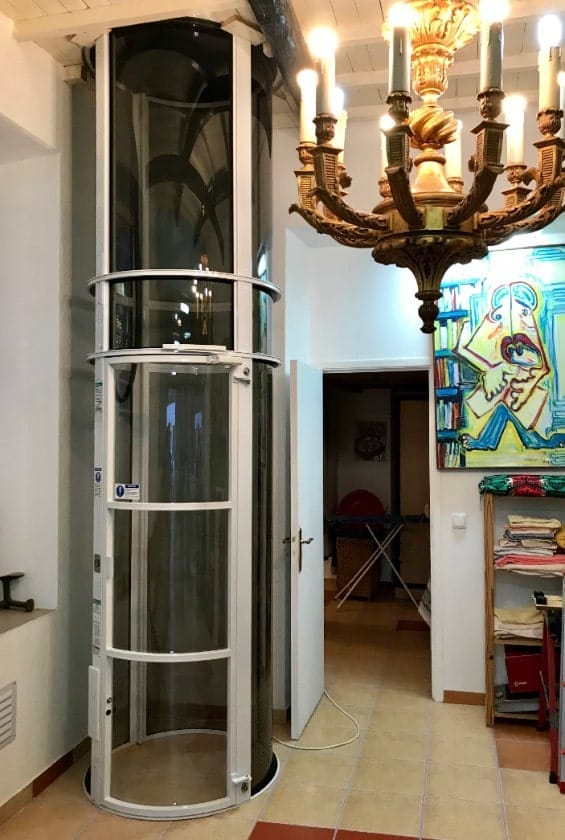
A through-floor lift travels vertically through a prepared opening between two levels of the home. It follows a separate route from the staircase and may accommodate a standing passenger, seated user or wheelchair, depending on the selected model.
These lifts can suit properties where direct travel is required between two floors but space for a conventional shaft is limited. Potential positions might connect a living room with a bedroom or a hallway with an upstairs landing.
The proposed location must work on both floors. Structural support, ceiling clearance, electrical requirements, fire separation and safe approach space all need to be considered during the survey.
Learn more about the installation and property requirements for through-floor lifts.
Domestic Home Lifts
A domestic lift provides vertical travel within its own structure or a purpose-designed enclosure. Home lifts can offer greater flexibility over cabin size, entrance direction, number of stopping points and interior finishes.
Compact systems may be suitable for established houses, while larger hydraulic, traction or panoramic lifts can be incorporated into substantial renovations and new interior layouts. Some models can accommodate wheelchairs or several passengers, subject to their dimensions and rated capacity.
A home lift may be appropriate when the equipment needs to serve more than two levels, provide additional cabin space or form part of the property’s design. The building work and technical requirements vary between systems, making an individual survey essential.
Explore the available home lifts for accessible and design-led residential projects.
Walk-In Baths and Safer Bathing
Accessibility is not limited to moving between floors. The bathroom can become difficult to use when stepping over a high bath edge, lowering into the water or standing on a wet surface becomes unsafe.
A walk-in bath uses a low-level door to reduce the height the user must step over. Depending on the model, it may include integrated seating, support handles and controls positioned for easier use.
The user’s ability to enter, close the door and remain seated while the bath fills and drains should be considered carefully. The bathroom layout, hot-water supply and available transfer space also affect suitability.
DHG Services provides walk-in baths for customers seeking a more accessible bathing arrangement.
Smaller Household Adaptations
A lift is not always the first or only improvement required. Smaller changes can make frequently used routes easier to navigate and may complement a larger mobility installation.
Useful adaptations can include securely fitted handrails, improved lighting, non-slip flooring and the removal of loose rugs or unnecessary obstacles. Thresholds may need to be reduced, and doors can sometimes be widened to provide better wheelchair access.
Furniture can also be repositioned to create clearer circulation routes. Frequently used storage, switches and controls should be placed within comfortable reach.
These changes should be considered together. A new lift will be less effective if the user cannot travel safely between the cabin, bedroom, bathroom and main living areas.
Comparing Stairlifts, Through-Floor Lifts and Home Lifts
The correct choice depends on how the user moves, the number of levels involved and the amount of space available within the property.
When a Stairlift May Be Suitable
A stairlift may be the preferred option when the user can transfer onto a seat, the staircase is the main barrier and limited building work is desired. It can provide a comparatively quick solution for straight or curved stairs.
The staircase must be wide enough for the seated passenger and should retain appropriate space for other users. Safe transfer areas are required at the top and bottom.
When a Through-Floor Lift May Be Suitable
A through-floor system may be more appropriate when the user needs to remain in a wheelchair or finds transferring onto a stairlift difficult. It can provide direct travel between two levels without following the staircase.
The property must contain a suitable vertical route, and enough space is required to approach and leave the lift safely at both stopping points.
When a Home Lift May Be Suitable
A larger domestic lift can suit customers requiring several stops, greater cabin capacity or a lift that forms part of a premium renovation. It may provide more options for wheelchair access, entrances and interior finishes.
The trade-off is that an enclosed home lift can require additional space, preparation and coordination with the building design.
Choosing an Accessible Lift for a Wheelchair User
A wheelchair-accessible lift must be selected using the occupied dimensions and weight of the chair. Labels such as “accessible lift” or “wheelchair lift” should not be accepted without checking whether the cabin suits the individual user.
Entrance width is important, but it is only one part of the assessment. The cabin must provide sufficient depth and internal space, while every landing needs a clear approach and exit route.
Turning space should be considered where the wheelchair cannot enter and leave in a straight line. The direction in which the doors open and whether opposite-side entrances are available can affect how easily the lift fits into the property.
Controls should be positioned within reach and should not require more strength or dexterity than the user possesses. Where a carer will travel with the wheelchair user, the combined space and weight requirements must be included in the specification.
Planning for Changing Mobility Needs
A home adaptation should solve the current problem while remaining useful as circumstances change. This does not mean choosing the largest or most complicated equipment available, but future requirements should be discussed during the survey.
Someone who can currently walk to a stairlift may later rely on a walking aid or wheelchair. A compact lift selected only for standing use might not provide sufficient cabin space in the future.
Households should consider which rooms must remain accessible, who will use the equipment and whether assistance may be needed. The route from the lift to the bedroom, bathroom and main entrance is just as important as the journey between floors.
Early planning can also help customers coordinate accessibility equipment with extensions, bathroom alterations or wider renovation work. This may reduce the need to disturb completed finishes at a later date.
Designing an Accessible Route Through the Home
Improving accessibility involves more than overcoming a single staircase. The complete journey through the property should be considered, including entrances, hallways, doors, floor surfaces and the destination rooms.
The most suitable lift position is not necessarily the first empty space identified. It should create convenient stopping points without obstructing doorways, furniture or important circulation routes.
For wheelchair users, turning circles and threshold heights can influence whether a theoretically accessible room can be used independently. Walking-aid users may need stable surfaces and sufficient space to move away from the lift before closing the door.
A well-planned route should feel natural during everyday use. The equipment should reduce unnecessary movement and connect the rooms that matter most to the household.
What Happens During a Home Accessibility Survey?
A home survey allows DHG Services to understand the access problem before recommending equipment. The surveyor will discuss who will use the adaptation, which parts of the property are difficult to reach and how mobility may change over time.
For a stairlift, the staircase, landings and transfer positions will be measured. For a vertical lift, possible routes must be assessed across every floor served. Ceiling height, floor structure, door positions, power requirements and nearby services can all influence the recommendation.
Wheelchairs, walking aids and other equipment should be available for measurement where possible. This helps confirm cabin size, entrance width and manoeuvring space rather than relying on assumptions.
Following the assessment, customers should receive a written proposal identifying the recommended system, selected features, preparation requirements, installation work and available aftercare.
Installation, Safety and Property Requirements
The installation process depends on the chosen mobility solution. A straight stairlift can usually be fitted with relatively little alteration, while a through-floor or enclosed lift may require structural preparation and additional coordination.
Building Regulations can apply when floors are altered, openings are formed or fire separation is affected. Listed properties, flats, rented homes and houses in multiple occupation may require further consent from an owner, freeholder, managing agent or local authority.
The proposed equipment should be installed according to the manufacturer’s requirements and tested before handover. Safety features, normal controls and emergency arrangements must be demonstrated clearly to the user.
Approval requirements vary between properties and projects. They should be identified before equipment is ordered rather than assumed from a general description online.
Budgeting for Home Accessibility Improvements
The cost of improving access depends on the equipment, property and preparation required. A straight stairlift will usually involve less work than a bespoke curved system or multi-stop domestic lift, but price should not be the only consideration.
Customers should compare suitability, expected use, warranty cover and ongoing maintenance as well as the initial quotation. Choosing equipment that cannot support future mobility may create a larger cost if it needs to be replaced.
Our dedicated guide explains current stairlift costs, while the Stiltz home lift price guide covers the factors affecting compact domestic lift quotations.
Eligible disabled people may be able to receive support for necessary adaptations. The official Disabled Facilities Grant information explains how qualifying homeowners and tenants can apply through their local council. Approval should be obtained before work begins, as grants should not be assumed until the application has been accepted.
Aftercare for Lifts and Stairlifts
Accessibility equipment should remain dependable after installation. Servicing allows controls, safety systems, batteries, doors and mechanical components to be checked at appropriate intervals.
Maintenance requirements differ between stairlifts, through-floor lifts and enclosed domestic lifts. The recommended schedule should be confirmed when the equipment is ordered and followed throughout its working life.
Users should report changes in operation rather than waiting for a complete breakdown. Warning signals, intermittent charging, unusual noises or inconsistent door movement can indicate that attention is required.
DHG Services provides ongoing support, including stairlift servicing and stairlift repairs, for customers requiring continued aftercare.
Why Choose DHG Services?
DHG Services provides a broad range of home accessibility solutions, allowing different products to be compared through one experienced team. The recommendation is based on the person and property rather than automatically directing every enquiry towards the same equipment.
Our process begins with a free, no-obligation survey. We explain the suitable systems, identify known preparation requirements and provide a written quotation before the customer decides whether to proceed.
Installation includes testing, commissioning and a user demonstration. Continued servicing and repair options are also available, providing support throughout the working life of the equipment.
Customers can explore the complete range of mobility services or speak with our team about the access challenges within their property.
Frequently Asked Questions About Home Accessibility
These answers cover common questions about disability aids, accessible lifts and choosing suitable mobility equipment for the home.
What Is the Best Home Accessibility Solution for Limited Mobility?
The answer depends on how the person moves, whether they use a wheelchair and which areas of the home have become difficult to access. A stairlift may suit someone who can transfer safely onto a seat, while a through-floor or domestic lift may be better when a wheelchair needs to travel between floors. A survey should consider the user, property and expected future requirements before equipment is recommended.
Can Several Accessibility Improvements Be Combined?
Yes. A household may benefit from a stairlift or vertical lift alongside bathroom adaptations, handrails, better lighting and clearer circulation routes. Combining improvements can create a complete accessible journey through the property rather than solving only one obstacle. Each adaptation should be planned so it works alongside the others and does not reduce the usable space required by the user.
Can Accessibility Equipment Be Installed in a Small House?
Many compact stairlifts and through-floor lifts are designed for established homes where space is limited. However, the proposed route must still provide sufficient clearance and safe access at every stopping point. Room dimensions, floor construction, staircase width and surrounding furniture should be measured before a product is selected. A home survey can determine which options are achievable without making the remaining rooms difficult to use.
Is a Stairlift Suitable for a Wheelchair User?
A stairlift may suit a wheelchair user who can transfer safely onto the seat at both ends of the staircase. Another wheelchair may be needed at the destination unless it can be moved separately. When transferring is difficult or the person needs to remain in their wheelchair, an appropriately sized through-floor or domestic lift may provide better access.
Do Home Accessibility Alterations Need Planning Permission?
Many internal adaptations do not require standard planning permission, but Building Regulations and other approvals may still apply. External changes, listed buildings, flats, rented homes and leasehold properties can require additional consent. Work affecting the structure or fire separation should be assessed properly. Requirements depend on the building and proposed equipment, so they should be confirmed before installation begins.
How Can I Compare Other Mobility Services?
DHG Services provides stairlifts, home lifts, through-floor lifts, walk-in baths and associated aftercare. The complete services range allows households to review alternative ways of improving access. During a survey, the team can compare solutions according to mobility, transfers, available space, required floors and likely long-term use.
Find the Right Accessibility Solution for Your Home
Home accessibility should make daily life easier without introducing equipment that does not suit the person or property. A considered assessment can help you compare stairlifts, accessible lifts, through-floor systems, bathing adaptations and smaller mobility aids.
DHG Services provides free home surveys, tailored recommendations, professional installation and ongoing support. Whether you need an immediate adaptation or want to prepare your home for the future, our team can explain the available options clearly.