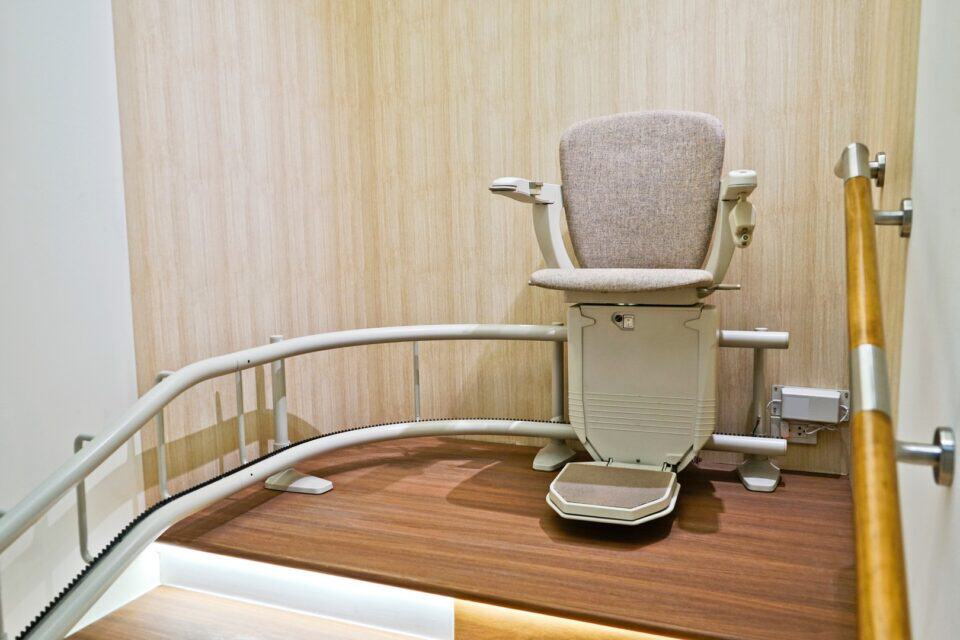
The main difference between a straight and curved stairlift is the route its rail follows. A straight stairlift serves an uninterrupted straight flight, while a curved stairlift accommodates bends, corners or intermediate landings.
That distinction usually determines which category you need before you begin comparing individual models. The chair, controls and available powered features then need to suit the person using the equipment.
Handicare offers both straight and curved systems, with different rail designs and seating arrangements across its range. Understanding those differences can help you ask more useful questions during a survey and assess the proposed specification.
DHG Services provides staircase surveys and equipment recommendations based on the property and intended user. This comparison explains the main considerations when looking at Handicare straight and curved stairlifts.
The Staircase Determines the Rail Type
A straight staircase follows one continuous direction between its lower and upper landing. Although its length, angle and width still need measuring, the rail does not need to negotiate a change in direction.
A curved installation follows a more complex route. Handicare describes its curved systems as made to measure for individual staircases, including arrangements with corners and intermediate landings.
A staircase does not need to look rounded to require a curved stairlift. Two straight flights joined by a landing may need a curved rail if the user requires one continuous journey between floors.
For example, a household with an L-shaped staircase might need the chair to travel around the corner without the user getting off halfway. The survey should assess that complete journey rather than considering each flight separately.
Handicare Straight Stairlifts: A Direct Route Between Floors
Handicare’s straight range includes the 1000 and 1100 models. Both serve straight staircases, but their specifications differ.
The Handicare 1100 uses a compact, grease-free rail and has folding seating components. The manufacturer also describes options such as a Slide Track or hinge arrangement to help manage nearby access restrictions.
The Handicare 1000 has a slim aluminium track, folding seat, arms and footrest, and optional powered features. Its range also includes different capacity versions, so the precise variant needs to be identified when reviewing a quotation.
These differences show why “a Handicare straight stairlift” is not a complete specification. Ask which model is proposed, what seat it includes and how the rail will finish at each end.
A suitable straight installation should provide comfortable travel and manageable boarding positions while leaving appropriate access for other staircase users.
Handicare Curved Stairlifts: Bespoke Rails for Turns and Landings
Handicare’s curved equipment includes the Freecurve single-rail system and the 4000 twin-rail system.
The Freecurve is made to suit the staircase and offers different seating styles and powered options. Its single-rail design also provides choices relating to appearance, including rail colours.
The Handicare 4000 uses a custom-built twin-rail arrangement. Available options include powered seat swivelling, a powered footrest and a hinged section where compatible with the proposed installation.
Bespoke planning involves more than following the bends. The proposed rail should also account for parking, boarding and the space around each landing.
A chair that finishes close to the stairs may suit one property, while another may benefit from a rail extension that brings it farther onto the landing. These decisions need to reflect the user’s movement and the available space.
Straight and Curved Stairlifts Compared
The following comparison summarises the main differences between the categories. Individual model features still need checking during the survey.
| Consideration | Straight stairlift | Curved stairlift |
|---|---|---|
| Staircase route | One continuous straight flight | Bends, corners or intermediate landings |
| Rail preparation | Prepared for the measured straight route | Made to suit the staircase’s individual route |
| Handicare examples | 1000 and 1100 | Freecurve and 4000 |
| Price | Generally lower for an equivalent straightforward installation | Generally higher because of the bespoke rail |
| User assessment | Seating, transfers, controls and clearance must be checked | The same checks apply, including clearance through turns |
Handicare’s pricing information explains that curved systems generally cost more because of their bespoke nature. It also identifies staircase dimensions, available space and selected features as factors affecting the quotation.
Seating and Transfers Matter in Both Categories
Choosing the correct rail type is only the beginning. The chair must also work for the person who will use it.
Consider how the user approaches the seat, sits down, positions their feet and stands after the journey. Seat height, arm spacing and access to the controls should all be discussed.
Handicare offers powered features on selected straight and curved configurations. A powered swivel can help someone turn towards the upper landing, while a powered footrest can reduce the need to bend to fold it. Availability depends on the model and seat combination.
Ask which features address an identified difficulty and which are optional preferences. This helps you assess their value without choosing solely from a brochure.
If transferring onto a chair is unsuitable, the assessment should consider whether another form of access would better meet the user’s needs.
Space Requirements Extend Beyond the Rail
A compact rail does not establish that the complete stairlift will fit comfortably.
The survey needs to consider the chair and user together. Seated knee clearance, foot position, headroom and the space required for boarding can all influence suitability.
Turns deserve particular attention because the relationship between the chair and nearby walls changes through the journey. Doors and narrow landings can also restrict movement at either end.
Imagine a staircase with a door immediately beside the bottom step. The proposed equipment needs to preserve access through that doorway, taking account of the rail and parked chair.
Ask to see where the equipment will sit when folded and where it will stop during normal use. Those positions can affect the household as much as the rail’s appearance.
Charging Arrangements Differ Between Models
Charging is an example of a feature that should be explained for the particular equipment.
Handicare describes the 1100 as having continuous charging along its rail. The 1000 has charging positions at the top and bottom as standard. You should therefore follow the parking instructions for the model installed.
When comparing proposals, ask where the chair needs to be parked and how you will recognise a charging problem. Establish whether its parking position remains convenient for everyone using the staircase.
The installation demonstration should cover normal operation, charging and any warning indicators. Keep the operating instructions accessible so you can refer to the correct guidance afterwards.
Avoid assuming that advice for another Handicare model applies to your equipment, even if the chairs look similar.
Installation Times Depend on the Agreed Specification
Straight and curved installations require different preparation, but the rail category alone does not determine the complete timetable.
A straight system still needs the correct equipment, rail length and selected features. A curved system requires its individual route to be measured and specified before the rail can be prepared.
Ask for the expected programme after the survey. Separate the equipment lead time from the fitting appointment, and establish whether any work at the property must happen beforehand.
On installation day, allow time for fitting, testing and the operating demonstration. If assistance is normally required, it can be useful for that person to attend the handover.
Changes to the specification should be confirmed before ordering. Altering a parking arrangement or selected feature later may affect both the proposal and schedule.
Compare Complete Quotes and Aftercare Arrangements
An accurate comparison should identify the manufacturer, model, rail arrangement, chair and selected features. It should also explain delivery, installation, testing and any known preparation work.
For example, one proposal may include a powered swivel and another manual operation. Comparing their total prices without recognising that difference could obscure an important requirement.
Warranty and servicing arrangements also deserve attention. Handicare recommends servicing its straight and curved equipment by an approved engineer at least annually, with more frequent attention potentially needed according to use.
Ask who will provide support, what is included and how additional work is charged. Confirm which arrangements apply to the particular equipment being offered.
Our experienced team can help you understand the proposed installation and available aftercare before you decide how to proceed.
Which Handicare Stairlift Is Right for Your Home?
The answer begins with your staircase, then moves to the seating, controls and features needed for everyday use.
A suitable straight flight points towards a straight system. A route involving turns or intermediate landings needs an assessment of curved equipment. Within either category, the recommendation should reflect the user and the actual installation space.
You can explore Handicare’s curved stairlift information to understand its bespoke rail approach and available options.
For customers in Northampton, our stairlift installation and aftercare services provide a starting point for discussing a property assessment.
Arrange a free home survey with DHG Services to compare suitable stairlift arrangements and receive a written quotation based on your home and requirements.