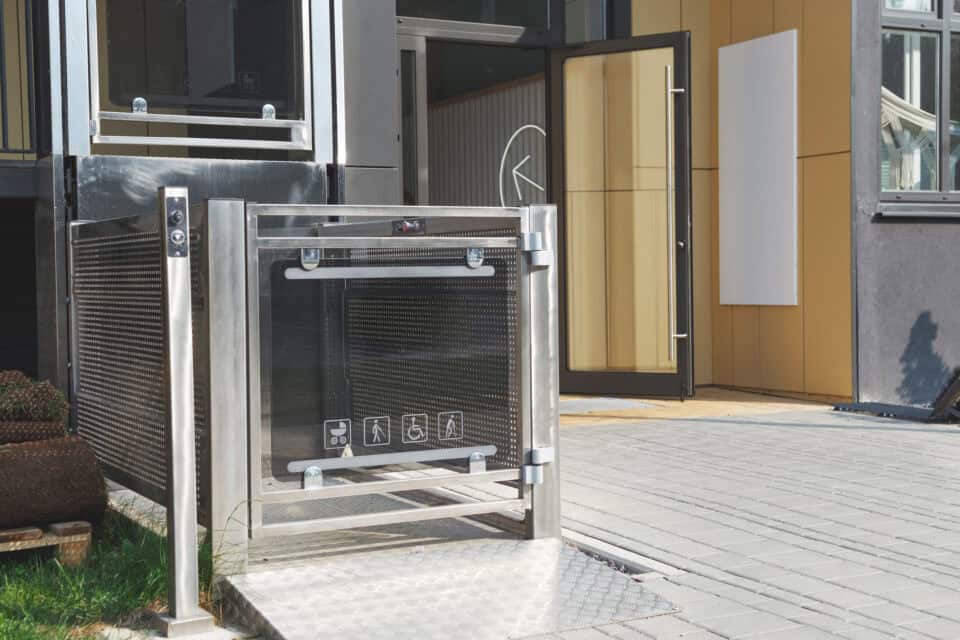
Moving around a property can become challenging when everyday routes involve steps, steep entrances or changes in floor level. For homeowners who need an easier way to access different parts of their property, an outdoor home elevator may provide a practical alternative to stairs.
Also known as external home lifts, these systems provide vertical access outside a building, connecting entrances, raised floors or other levels without necessarily requiring major changes to the internal layout.
However, not every outdoor lifting system works in the same way. Understanding the differences between enclosed home lifts, platform lifts and other accessibility equipment is an important first step when exploring the available options.
Understanding Outdoor Home Elevators
An outdoor home elevator is a lifting system positioned outside a residential property to transport people vertically between different levels. Depending on its design, it may provide access from ground level to an elevated entrance, connect two floors externally or help overcome a significant change in height.
In the UK, the terms external home lift, outdoor domestic lift and external platform lift are often used when discussing these solutions. Although these descriptions sometimes overlap in everyday conversation, they do not necessarily refer to identical equipment.
Some systems use an enclosed cabin, while others have a platform surrounded by protective barriers and gates. The appropriate arrangement depends on the people using it, the distance travelled and the building itself.
Unlike conventional indoor lifts, externally positioned equipment must also be suitable for its outdoor environment. Exposure to rain, temperature changes and other weather conditions affects how a system is designed and protected.
The main purpose remains straightforward: to provide a safer, more manageable route between levels for people who may find steps or stairs difficult.
How Do Outdoor Home Elevators Work?
Outdoor home elevators use a powered lifting mechanism to move a cabin or platform vertically along a guided route. Passengers enter at a designated stopping point, operate the lift using its controls and exit when it reaches the required level.
The underlying mechanism varies between products. Some lifting systems use hydraulic technology, while others rely on screw-driven or traction-based arrangements. Each has its own design characteristics, operating requirements and suitability considerations.
External lifts also need a suitable arrangement for guiding and supporting their movement. Depending on the equipment, this may involve a dedicated structure, an enclosed shaft or a manufacturer-designed supporting framework.
Access is another important part of how the system operates. A lift might open directly onto a raised entrance, for example, or connect with a landing beside an upper-floor doorway. Both stopping points need to provide appropriate space for people to enter and leave comfortably.
Safety features vary according to the type and specification of the lift. These may include controlled movement, interlocked access gates, emergency stop functions and arrangements for responding to a power failure.
Rather than assuming every outdoor elevator offers the same capabilities, homeowners should consider the specifications of the particular equipment and the needs of its intended users.
Different Types of Outdoor Home Lifts
Outdoor lifting solutions come in several forms, and the term home elevator is sometimes used broadly to describe equipment with quite different functions.
Understanding the main categories helps clarify which systems may be relevant to a particular property.
Enclosed Outdoor Home Lifts
Enclosed outdoor home lifts transport passengers within a cabin or suitably protected lifting space. They can provide an alternative route between different levels of a building, particularly where an internal lift is difficult to accommodate.
Some enclosed systems resemble compact passenger lifts, with doors, a dedicated lifting structure and controls for travelling between floors.
Their suitability for outdoor use depends on the specific product, its enclosure and the protection provided for its electrical and mechanical components.
An indoor home lift should never automatically be assumed suitable for installation outside.
External Vertical Platform Lifts
External vertical platform lifts provide access between levels using a lifting platform, which may be partly or fully enclosed depending on the design.
These systems are commonly considered where a person needs to overcome steps or reach an elevated entrance without using a staircase.
Certain models can accommodate wheelchair users, provided the platform dimensions, weight capacity, entrance arrangement and surrounding access space meet their requirements.
Platform lifts and enclosed domestic passenger lifts can offer similar practical benefits, but they may differ considerably in their construction, controls, operating characteristics and intended applications.
Choosing Between Enclosed and Platform Designs
The distinction is not simply whether one lift looks more attractive than another. An enclosed cabin may offer a different passenger experience and level of environmental protection, while a platform lift might be suited to a more specific access challenge. The height between levels, frequency of use, mobility requirements and available space all influence which category deserves further consideration. There is no single outdoor lift design that is appropriate for every household.
What Are the Benefits of an Outdoor Home Elevator?
One of the main advantages of an outdoor home elevator is the possibility of improving access without positioning the lifting equipment entirely inside the property.
For homes with limited internal space, this can be particularly appealing. Creating room for an indoor lift may involve changing the arrangement of existing rooms, whereas an external solution offers a different approach to connecting levels.
Outdoor lifts can also help people maintain access to parts of their home that have become difficult to reach. An elevated entrance or a floor reached by external steps may present a significant obstacle for someone with reduced mobility.
Depending on the equipment and the property, a suitable lift could allow a wheelchair user or someone who struggles with stairs to move between those levels more comfortably.
Another consideration is independence. Having a convenient route between levels may reduce the need for assistance with certain everyday journeys, although individual needs and safe operation must always be assessed.
External lifting systems can also provide an accessibility option when an existing staircase cannot easily accommodate an alternative.
These advantages are not guaranteed for every building. The practical benefit depends on selecting a system that genuinely suits the intended users and connects the spaces they need to reach.
Are Outdoor Home Elevators Suitable for Every Property?
Although outdoor home elevators can provide useful accessibility solutions, they are not suitable for every property or every mobility requirement.
The position of the building and the relationship between its different levels are important starting points. A raised entrance with sufficient external space may offer different possibilities from a property with narrow pathways or limited room beside its exterior walls.
The locations where passengers enter and leave the lift also matter. A convenient lifting route is of limited value if someone cannot approach it safely or move comfortably away from the upper landing.
For wheelchair users, accessibility must be considered throughout the journey, not simply while travelling inside the lift. Doorways, approach routes and the surrounding space all contribute to whether the arrangement is genuinely practical.
Weather exposure is another factor. Equipment positioned outside must be specified for the conditions it will encounter, including moisture, temperature changes and any particularly exposed location.
Homeowners should also think about who will use the lift and how often. Equipment intended for a wheelchair user may require different features from a system used primarily by someone who finds stairs tiring.
These considerations help establish whether an outdoor lift is worth investigating. Detailed questions about construction, permissions, installation arrangements and costs should then be addressed when assessing a particular system and property.
Understanding Your Outdoor Lift Options with DHG Services
Choosing suitable access equipment begins with understanding the problem it needs to solve. An outdoor elevator may be worth considering where there is a substantial change in level or where an indoor lifting arrangement is impractical.
However, other mobility solutions may be more appropriate in some situations. For example, stairlifts can provide access along an existing staircase without offering the same type of vertical travel as a home elevator.
Outdoor stairlifts and step lifts are separate equipment categories rather than forms of enclosed home elevator. Their suitability depends on the route, the user and the particular installation.
For homeowners comparing domestic lifting options, the home lifts in Staffordshire service page provides an introduction to DHG’s home-lift offering. The company also provides support for existing stairlift equipment, including stairlift repairs in Stafford, which is a separate service from outdoor elevator installation or maintenance.
The most useful starting point is to establish what access is required, what obstacles exist and which type of equipment is appropriate.
If you are considering changes to improve mobility around your property, DHG Services can discuss its available accessibility solutions and help you explore suitable next steps. Understanding your options before committing to a particular product is an important part of making a well-informed decision.