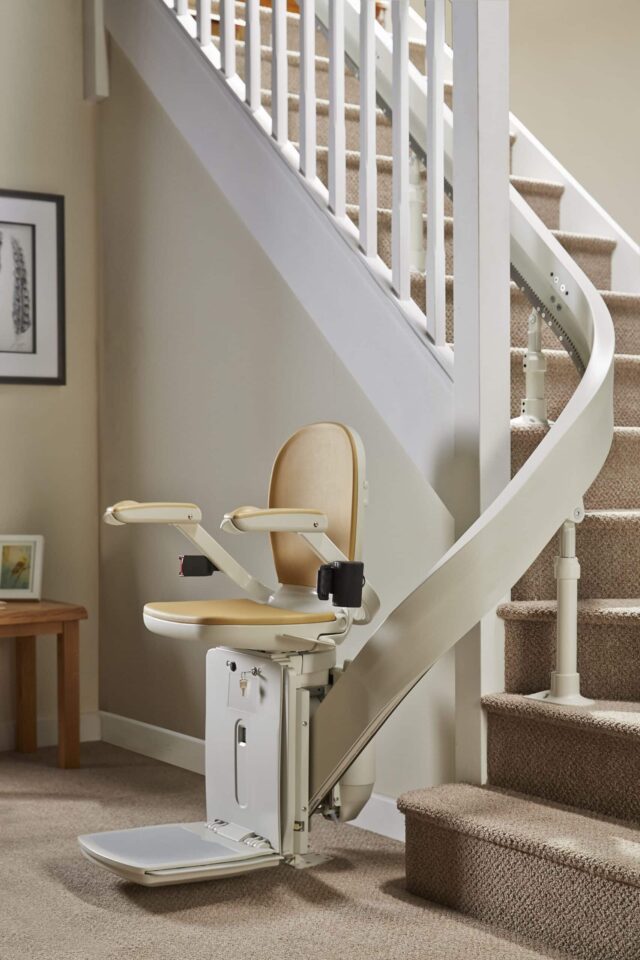
Choosing a stairlift involves more than selecting a chair and rail. The quality of the survey, advice, installation and aftercare can all affect how safely and comfortably the stairlift works within your home.
A reliable stairlift installer should take time to understand the person using the lift, measure the staircase accurately and explain the available options without unnecessary pressure. They should also provide a clear written quotation and remain available for servicing and repairs after installation.
DHG Services provides professional stairlift installation in Stafford and across Staffordshire and the wider Midlands. Every installation begins with a free home survey so the recommended stairlift can be matched to the user and staircase.
Why the Stairlift Installer Matters
Modern stairlifts include features intended to support safe, comfortable and controlled travel. However, even a well-designed product must be specified and installed correctly.
The rail needs to fit the staircase accurately without creating unnecessary obstructions. The seat should provide sufficient support, the controls must be accessible and the user needs enough room to get on and off safely.
A professional installer also considers how other people use the staircase. Folding seats, footrests, armrests and hinged rail sections can help keep hallways, doorways and stair treads accessible when the lift is parked.
Choosing the correct installer therefore affects the product recommendation, the standard of the fitting and the support available throughout the stairlift’s working life.
Start with the Needs of the Stairlift User
A stairlift should be chosen around the person who will use it. The installer should ask about mobility, balance, strength, joint movement and any difficulty transferring between the lift and the landing.
Someone with restricted movement in their knees or hips may need a different seat height. A person who finds twisting difficult may benefit from a powered swivel seat, while limited grip strength could affect the most appropriate control.
The survey should also consider anticipated changes. A basic model might address the immediate problem, but an additional feature could make the stairlift easier to use if the person’s mobility changes.
A responsible installer will also explain when a seated stairlift may not be the safest solution. If transferring is difficult or a wheelchair must travel between floors, one of DHG Services’ other home mobility solutions may be more appropriate.
Local Stairlift Installer or Nationwide Company?
Older advice often assumes that the largest nationwide company will provide the best service. In reality, installation quality and aftercare depend on the team serving the customer’s area rather than the size of the company’s advertising campaign.
A local or regional installer can provide valuable advantages. The engineers are more likely to understand the homes and common staircase layouts found throughout the region. Travel distances may be shorter, and arranging a survey, service visit or repair can be more straightforward.
This does not mean that every local installer is automatically suitable. Customers should still check experience, product knowledge, accreditation, warranties and aftercare arrangements.
DHG Services focuses on Stafford, Staffordshire and the wider Midlands. This regional approach supports local surveys, professional installations and continuing assistance from engineers familiar with the equipment.
Look for Relevant Experience and Accreditation
Ask how long the company has been installing stairlifts and whether its engineers are trained to work with the proposed manufacturer and model.
Manufacturer accreditation can demonstrate that the installer has access to appropriate technical guidance, equipment and replacement parts. DHG Services is an Acorn-accredited partner and supplies straight and curved Acorn stairlifts for suitable homes.
Accreditation should not replace other checks. The customer should still ask who will complete the installation, whether subcontractors are involved and who will take responsibility if a problem develops.
A trustworthy installer should be comfortable explaining its experience and should not rely on vague claims such as being the “best” or “leading” provider without meaningful supporting information.
Why a Home Survey Is Essential
A quotation based only on a brief telephone conversation may overlook important details. Photographs can help with an initial enquiry, but an on-site survey provides a more reliable assessment.
During the survey, the installer should measure the staircase and examine the available clearance. This includes the width of the stairs, headroom, landing space, nearby doorways and potential obstructions at the bottom of the rail.
The surveyor should also assess how the person will transfer onto and off the seat. A stairlift that physically fits the staircase may still be unsuitable if there is not enough space to stand safely at the upper landing.
Electrical supply and charging positions should be considered, along with whether a folding or hinged rail will be required. The survey should result in a recommendation that addresses both the property and the user.
Straight and Curved Stairlifts
The shape of the staircase is one of the main factors determining the type of stairlift required.
Straight Stairlifts
A straight stairlift is designed for a single flight without bends, corners or intermediate landings. It uses a standard straight rail, making it simpler to prepare and generally more affordable than a made-to-measure curved system.
DHG Services supplies and installs straight stairlifts in Stafford for people who want a safe and convenient way to regain access to both floors.
Although straight stairlifts are relatively straightforward to install, accurate measurement remains important. The installer must ensure that the rail finishes in appropriate positions and does not obstruct doors, hallways or access routes.
Curved Stairlifts
A curved stairlift is required when a staircase turns, bends, contains a half landing or changes direction. Its rail is designed around the precise shape of the staircase rather than cut from a standard straight section.
Because the rail is made specifically for the property, a careful survey is particularly important. Every bend, transition and landing must be measured accurately.
Homeowners with more complex staircases can explore curved stairlifts. The installer should explain the proposed rail route, parking position and expected lead time before an order is placed.
Features a Good Installer Should Discuss
The most appropriate features depend on the user. A good installer should explain their purpose rather than automatically adding every available upgrade.
A swivelling seat can allow the user to turn away from the open staircase before standing. Depending on the model, this may be operated manually or powered. Powered options can help someone with reduced strength or restricted movement.
Folding arms, seats and footrests help preserve space for other staircase users. A powered footrest can be beneficial when bending down to fold the footplate would be uncomfortable or unsafe.
A hinged rail may be needed where the bottom of the rail would otherwise cross a doorway or walkway. Remote call controls allow the stairlift to be moved between floors when it is not occupied.
Many modern stairlifts use rechargeable batteries and continue operating for a limited number of journeys during a power interruption. The installer should explain how the batteries charge, where the lift should be parked and what warning signs indicate a charging problem.
Stairlift Safety Features
Available safety features vary between manufacturers and models, but commonly include a seat belt, obstruction sensors, controlled acceleration and braking, swivel-seat interlocks and an emergency stop function.
The installer should demonstrate each feature and explain what happens if an object blocks the rail or footrest. The user should also be shown the safest way to enter, travel and leave the stairlift.
A professional handover should not be rushed. The engineer should remain until the user or assisting family member understands the controls, charging position and basic fault indicators.
Any claims about safety standards, warranties or performance should relate to the actual model being supplied. Customers should request written product information rather than relying on general statements.
Comparing Stairlift Quotations
The lowest initial price is not always the best value. One quotation may include the survey, equipment, fitting, warranty and demonstration, while another may charge separately for important features or follow-up support.
Each written quotation should identify the stairlift model, whether it is new or reconditioned, the rail configuration and all selected options. It should also state the total price, applicable VAT treatment, anticipated installation schedule and any work excluded from the figure.
Customers should ask whether powered features, a hinged rail, additional call controls or electrical work are included. Warranty length and coverage should also be confirmed rather than assumed.
Avoid making a decision during the first visit simply because a temporary discount or same-day offer is presented. A stairlift is an important mobility purchase, and the customer should have enough information to compare the proposed solutions properly.
New and Reconditioned Stairlifts
A new stairlift can provide the latest available specification and a complete manufacturer-backed history. It may offer the greatest range of finishes, powered features and seating options.
A professionally reconditioned stairlift can provide a more affordable alternative. However, the customer should ask what has been inspected or replaced, how old the equipment is and what warranty is included.
Straight rails can sometimes be adapted for another suitable staircase. Curved rails are made to fit a specific staircase, so reusing them is usually more complicated and may not be appropriate.
DHG Services offers stairlift refurbishment for customers looking for a professionally assessed alternative to buying completely new equipment.
What Happens During Installation?
Before the installation date, the rail is prepared according to the measurements taken during the survey. A curved rail normally requires additional design and manufacturing time because it must follow the individual staircase.
During installation, the rail is generally fixed to the stair treads rather than directly to the wall. This means a stairlift can often be fitted without extensive structural work.
The engineer installs the carriage and seat, establishes the charging arrangement and checks the complete route. Sensors, controls, stopping positions and swivel mechanisms should then be tested before the lift is handed over.
Installation time depends on the product and staircase. A standard straight stairlift may be installed within a few hours, while curved systems or unusual access conditions may take longer. The installer should confirm the anticipated schedule for the individual property.
The Importance of Servicing and Repairs
Support should not end once the stairlift has been installed. Regular servicing can help identify worn components, charging problems and adjustments before they lead to a breakdown.
Ask whether the installer maintains the models it supplies and whether genuine or suitable replacement parts are readily available. The company should also explain how repair appointments are arranged and whether assistance is available when the lift cannot be used.
DHG Services provides stairlift servicing to help keep equipment operating reliably. Customers experiencing a fault can also arrange professional stairlift repairs in Stafford.
Keeping the installer’s telephone number close to the stairlift can be helpful for the user and family members if advice is needed.
Questions to Ask a Stairlift Installer
Before accepting a quotation, ask the installer which model is being recommended and why it suits the user. Establish whether it is new or reconditioned and which optional features are included.
The installer should explain how the stairlift will fit around doors, radiators and normal movement through the hallway. Ask how the user will transfer safely at both ends and whether other household members will still have sufficient staircase space.
Confirm the warranty, servicing schedule and breakdown arrangements in writing. It is also helpful to ask who will carry out the installation and whether the same company will provide future maintenance.
Clear answers demonstrate that the recommendation has been properly considered. Vague responses, unexplained costs or pressure to sign immediately should be treated cautiously.
Funding and VAT Relief
Some disabled people and those living with certain long-term illnesses may qualify for VAT relief on eligible mobility equipment. Eligibility is subject to specific conditions and should be confirmed before accepting a quotation.
A Disabled Facilities Grant may also help an eligible person pay for an essential home adaptation. Applications are handled by local councils and should normally be made before equipment is ordered or work begins.
Current information about possible support is available through the Government’s Disabled Facilities Grant guidance. Customers should check their individual eligibility rather than assuming that funding or VAT relief will automatically apply.
Frequently Asked Questions About Choosing a Stairlift Installer
How do I know whether a stairlift installer is trustworthy?
Look for relevant installation experience, manufacturer training or accreditation, clear company details and a willingness to provide a written quotation. The installer should assess the user as well as the staircase and explain why a particular model is being recommended. Avoid relying entirely on unverified claims or online reviews. Warranty terms, servicing arrangements and responsibility for future repairs should all be confirmed before an order is placed.
Should a stairlift installer visit before providing a quote?
A home survey is strongly recommended before a final quotation is agreed. Photographs and telephone discussions can support an initial estimate, but they may not reveal landing clearance, transfer difficulties, nearby doors or charging requirements. An on-site visit allows the installer to measure accurately and assess how the stairlift will work within the property. The resulting quotation should identify the model, configuration, included features and complete price.
Is a local stairlift installer better than a nationwide company?
Neither option is automatically better, but local aftercare is an important consideration. A regional installer may be able to provide faster surveys, installation appointments and repair visits because its engineers already operate nearby. Customers should still compare product choice, accreditation, quotation detail and warranty terms. DHG Services serves Stafford, Staffordshire and the wider Midlands, providing installation and continuing support through a locally based team.
Does the cheapest stairlift quotation offer the best value?
Not necessarily. A low quotation may exclude powered features, a hinged rail, electrical preparation, servicing or an appropriate warranty. It may also relate to reconditioned equipment when another quotation covers a new lift. Compare the exact model, condition, rail, features, installation scope and aftercare. The best value is the stairlift that safely meets the user’s requirements and is supported throughout its expected working life.
Which areas does DHG Services cover for stairlift installation?
DHG Services is based in Stafford and covers Staffordshire and a broad part of the Midlands. Available location services include Stoke-on-Trent, Lichfield, Wolverhampton and across the West Midlands. Customers outside the listed locations can contact the team to confirm whether their address is covered.
What support should be available after installation?
The installer should provide operating instructions, warranty information and contact details for servicing or repairs. Ask whether the company maintains the brand it supplies, stocks appropriate parts and can arrange assistance if the stairlift stops working. Regular servicing should be completed according to the manufacturer’s guidance and frequency of use. Keeping aftercare with an installer familiar with the equipment can make future maintenance more straightforward.
Arrange a Free Stairlift Survey
The right stairlift installer will recommend equipment based on the user, staircase and long-term requirements rather than relying on a standard package.
DHG Services provides free home surveys, written quotations and professional stairlift installation across Stafford, Staffordshire and the wider Midlands. Contact DHG Services to arrange an assessment and discuss the most suitable stairlift for your home.