The Essential Guide to Stairlift Features: Improving Home Mobility with DHG Services
For many people, the staircase is one of the first parts of the home to become difficult. What was once a normal and thoughtless part of the day can gradually become tiring, painful, or even frightening. Age-related changes, arthritis, joint pain, injury, reduced balance, muscle weakness, and long-term health conditions can all make stairs a serious challenge inside the home.
When that happens, daily routines begin to change. A person may avoid going upstairs unless necessary. They may stop carrying items on the stairs. They may begin relying on family members for help, or they may quietly start living on just one floor of the house. Over time, this can reduce independence, confidence, comfort, and overall quality of life.
A stairlift can change that.
Modern stairlifts are designed to do much more than carry someone up and down the stairs. They are carefully engineered mobility systems built to restore safe movement, reduce risk, and make daily life easier. With the right features, the right fit, and the right installation, a stairlift becomes a natural and dependable part of the home.
At DHG Services, we specialise in providing both straight and curved stairlifts for a wide range of homes and mobility needs. Whether your staircase is narrow, steep, straightforward, or includes turns and landings, our goal is always the same: to provide the safest, most suitable, and most reliable solution possible. We are committed to making sure every lift installation is the best it can be, because safety, comfort, and long-term confidence should never be compromised.
This complete guide explains the features that matter most in a modern stairlift, why they are important, how they improve everyday life, and what you should expect when choosing a system for your home.
Why Stairlift Features Matter So Much
A stairlift is not just a motorised chair on a rail. It is a complete accessibility solution designed to work safely and smoothly every single day. The best stairlifts combine mechanical reliability with thoughtful design, supportive seating, intuitive controls, and advanced safety features.
Understanding these features matters because the right stairlift is not simply the one that fits your stairs. It is the one that fits your life.
The user may need extra support when sitting or standing. They may have limited strength in their hands. They may need a seat that swivels automatically at the top of the stairs. They may need the bottom rail to fold away because a doorway sits close to the foot of the staircase. They may need something compact and discreet so other members of the household can still use the stairs comfortably.
These are not small details. They are the difference between a stairlift that merely works and a stairlift that truly supports independence.
At DHG Services, every recommendation begins with the understanding that safety and suitability come first. It is never enough for a stairlift to “probably work” or to “just about fit.” It must be right for the environment, right for the user, and right for long-term dependable use. If a stairlift is not the best answer, that will be said honestly. We believe that peace of mind comes from knowing the solution has been chosen carefully and correctly from the start.
Smooth Start-and-Stop Technology
One of the most important features in a modern stairlift is smooth start-and-stop movement. This may sound like a small technical detail, but in everyday use it makes a major difference.
Older or lower-spec systems can feel abrupt when they begin moving or when they stop. That sudden jolt can be uncomfortable, unsettling, and in some cases physically painful, especially for people with arthritis, back pain, hip problems, or reduced balance.
A modern stairlift with soft start and soft stop technology moves gently. Instead of jerking into action, it accelerates in a controlled way and slows down smoothly as it reaches the landing.
This matters because it helps:
- reduce strain on joints and muscles
- improve comfort during the journey
- build confidence for nervous users
- make daily use feel calmer and safer
- reduce fatigue over repeated trips
For many people, a smooth ride is not simply a comfort feature. It is a core part of making the stairlift feel secure and easy to trust.
Seating, Ergonomics, and Everyday Comfort
A stairlift should feel supportive from the moment the user sits down. Good seating design is one of the most important parts of the overall experience because the person using the lift needs to feel stable, comfortable, and properly positioned throughout the journey.
Modern stairlifts are designed with ergonomics in mind. That means the seat is shaped and built to support posture and reduce unnecessary strain.
Important comfort-focused features may include:
- a padded seat for support and pressure reduction
- a supportive backrest for improved posture
- adjustable armrests for different body sizes
- seat height options to make sitting and standing easier
- well-balanced positioning to support confidence in use
The right seating setup makes a big difference, especially for users with limited mobility, reduced core strength, arthritis, or pain in the hips and knees. A stairlift that feels awkward or difficult to transfer onto is unlikely to be used with confidence. A stairlift that feels natural and supportive quickly becomes part of daily routine.
At DHG Services, proper fit is always part of the process. A stairlift should suit the user, not just the staircase.
Safety Comes First Every Time
Safety is at the heart of everything DHG Services does. This is not just about installing a stairlift that technically operates. It is about making sure the stairlift is the safest and most appropriate option for both the user and the home.
Every property is different, and every person has unique mobility needs. That is why a one-size-fits-all approach does not work. A lift must be assessed in the context of the staircase, the surrounding layout, the user’s comfort, and their long-term safety.
This includes considering:
- how the user gets on and off the stairlift
- whether the staircase allows safe transfer at the top and bottom
- whether the user can bend comfortably
- whether manual or powered features are more suitable
- whether the rail placement creates any practical issues in the home
- whether another solution might actually be safer
DHG Services will never install something that only “might do.” If a stairlift is not the right solution, that will be explained clearly. The goal is always the same: to recommend and install a system that performs exactly as it should and gives complete peace of mind to the user and their family.
Powered Swivel Seat
A powered swivel seat is one of the most valuable features for many users, particularly when safety at the top landing is a concern.
This feature allows the seat to rotate automatically at the top of the stairs so that the user can stand up facing away from the staircase rather than twisting awkwardly near the stair edge.
This is especially useful for people who have:
- reduced hip mobility
- knee pain
- limited balance
- weakness when twisting or turning
- reduced confidence at the landing
A powered swivel seat helps by:
- reducing physical strain
- making standing up safer
- improving confidence during transfer
- lowering the risk of awkward movement at the top of the stairs
For some users, this feature makes the difference between a stairlift that feels manageable and one that feels genuinely easy and secure to use.
Powered Footplate and Linked Folding Features
Bending down can be difficult, uncomfortable, or unsafe for many stairlift users. That is why a powered footplate is such a useful feature.
Instead of having to lean down and lift the footrest manually, the user can fold it with a button press. On some systems, the armrests and footplate may be linked so they move together.
This helps by:
- removing the need to bend
- reducing strain on the back and knees
- lowering the risk of losing balance while leaning forward
- making the lift easier to use independently
- helping keep the staircase clear when the lift is parked
This is a practical feature, but for many people it also becomes an important confidence feature. If someone struggles with bending or has pain in the lower back, hips, or knees, a powered footplate can make daily use much more comfortable.
Hinged or Retractable Rails
Not every staircase ends in a wide open hallway. In many homes, the bottom of the stairs sits close to a doorway, corridor, or frequently used walking route. In those situations, a stairlift rail that continues to the floor could create an obstruction or trip hazard.
A hinged or retractable rail solves that problem.
This feature allows the lower section of the rail to fold away when the stairlift is parked, keeping the access route clear.
Its advantages include:
- preserving access to nearby doors
- preventing the rail from blocking hallways
- reducing trip hazards
- helping the stairlift integrate more neatly into the home
This type of feature is often identified during the survey stage. At DHG Services, the staircase is never assessed in isolation. The surrounding space matters just as much as the stairs themselves, because the stairlift needs to work safely within the whole home environment.
Space-Saving Foldable Design
One of the concerns many homeowners have is whether a stairlift will make the staircase feel cramped or difficult for other people to use.
Modern stairlifts are designed to be as compact and discreet as possible. Most include foldable features so that when the lift is not in use, it sits neatly against the staircase.
These space-saving elements often include:
- a folding seat
- foldable armrests
- a foldable footrest
- slim-profile rails
- a compact carriage design
This means the stairs can remain practical for other household members while still providing safe and reliable access for the stairlift user.
A good stairlift should feel like part of the home, not something that dominates it. Thoughtful, foldable design helps achieve that balance.
Straight and Curved Stairlifts: What Changes?
One of the biggest choices in stairlift installation is whether the staircase requires a straight or curved system.
Straight Stairlifts
Straight stairlifts are suitable for staircases that run in one uninterrupted line with no bends or landings.
They are often chosen because they offer:
- faster installation
- strong reliability
- simpler engineering
- good value
- excellent everyday practicality
For many homes, a straight stairlift is a highly effective and efficient mobility solution.
Curved Stairlifts
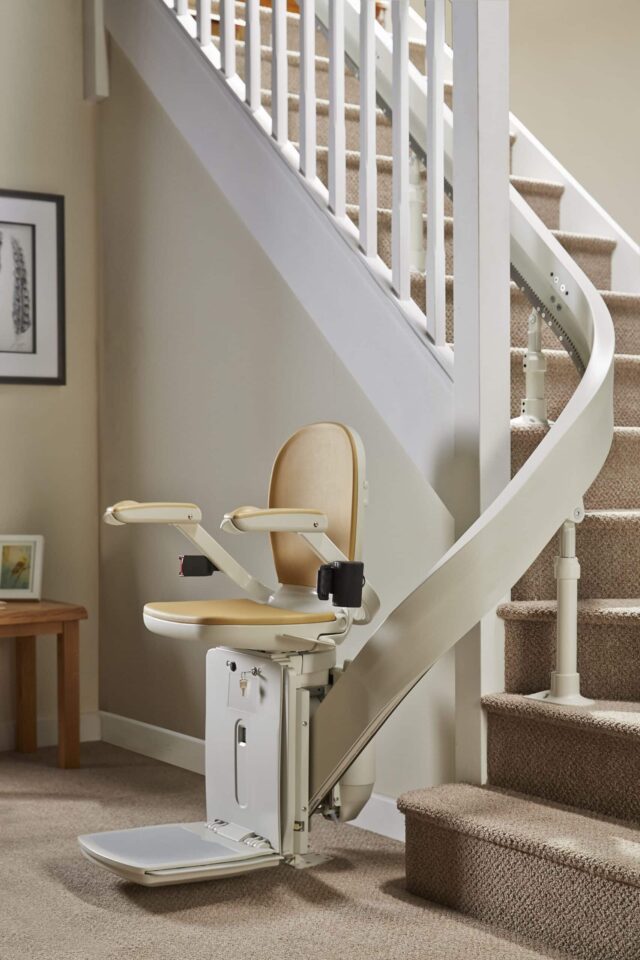
Curved stairlifts are designed for staircases with bends, turns, intermediate landings, or more complex layouts.
They offer:
- a custom-made rail shaped exactly to the staircase
- smooth travel around corners
- flexible parking positions
- elegant integration into difficult stair layouts
Because curved systems are bespoke, accurate surveying is especially important. Every measurement needs to be correct so the finished ride feels smooth, safe, and natural.
At DHG Services, we help homeowners understand which type is required and why. The recommendation is always based on the staircase itself and the needs of the person using it.
What to Expect During Installation
Many people are surprised by how straightforward stairlift installation can be when it is planned properly.
At DHG Services, we focus on accuracy, cleanliness, and minimal disruption throughout the process.
A typical installation process includes:
Free Home Survey
This is where the staircase is measured, the layout is assessed, and the user’s mobility needs are discussed. This stage is crucial because it ensures the correct solution is chosen from the outset.
Planning and Preparation
For straight stairlifts, planning is usually simpler because the rail is straightforward. For curved stairlifts, the measurements are used to manufacture a bespoke rail that follows the staircase exactly.
Professional Installation
Qualified engineers install the stairlift securely and carefully, fixing the rail to the stair treads rather than the wall.
Testing and Demonstration
Once fitted, the stairlift is fully tested. The user is then shown how to operate it, fold it, park it, and use it safely.
Most straight stairlifts can be installed in just a few hours. Curved stairlifts involve more preparation because of the custom rail, but the on-site fitting process is still designed to be efficient and tidy.
Running Costs and Energy Efficiency
Stairlifts are generally economical to run, especially compared with the value they provide in daily safety and independence.
Typical ongoing considerations include:
- low electricity usage
- periodic battery replacement
- optional servicing plans
- occasional wear-component replacement over time
Because most systems use rechargeable batteries and efficient controls, the day-to-day running cost is usually low. This makes stairlifts a practical long-term mobility solution for many households.
Lifespan and Maintenance
A well-made stairlift, installed correctly and looked after properly, can provide many years of dependable service.
In most cases, stairlifts last around:
- 10 to 20 years, and often longer with good servicing
Lifespan depends on factors such as:
- build quality
- frequency of use
- the home environment
- user habits
- regular maintenance
Annual servicing helps keep the lift operating smoothly and safely. It also allows small issues to be addressed before they become more significant.
At DHG Services, aftercare matters. Installing a stairlift is not the end of the service. Ongoing support, maintenance, and honest guidance are all part of making sure the lift remains dependable for years to come.
Running Costs and Energy Efficiency
Stairlifts are generally economical to run, especially compared with the value they provide in daily safety and independence.
Typical ongoing considerations include:
- low electricity usage
- periodic battery replacement
- optional servicing plans
- occasional wear-component replacement over time
Because most systems use rechargeable batteries and efficient controls, the day-to-day running cost is usually low. This makes stairlifts a practical long-term mobility solution for many households.
Lifespan and Maintenance
A well-made stairlift, installed correctly and looked after properly, can provide many years of dependable service.
In most cases, stairlifts last around:
- 10 to 20 years, and often longer with good servicing
Lifespan depends on factors such as:
- build quality
- frequency of use
- the home environment
- user habits
- regular maintenance
Annual servicing helps keep the lift operating smoothly and safely. It also allows small issues to be addressed before they become more significant.
At DHG Services, aftercare matters. Installing a stairlift is not the end of the service. Ongoing support, maintenance, and honest guidance are all part of making sure the lift remains dependable for years to come.